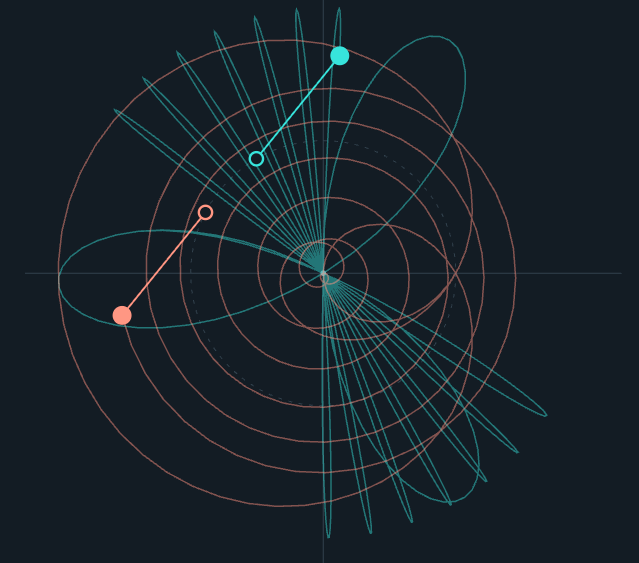
Firespinning with poi involves spinning balls of fire around on chains:
Or the poi can be spinning in opposite directions, which is called “butterfly”:
The hands holding the chains can move, too; by moving the hands in circles in either the same direction as the poi or the opposite direction, you can create “flowers” that are either “inspin” or “antispin”:
These have all been mathematical models so far. Here’s what happens if you change that last flower to a physics simulation, taking gravity into account:
This one holds up for a while, but eventually falls apart. In real life, for many patterns humans can approximate the mathematical path by making lots of subtle adjustments to their hand position and rotation speeds:
Not all mathematical patterns are physically possible; and some are easier than others to achieve.
Poi moves are typically taught and described by name — three-beat weave, fountains, dragonfly — but these can be imprecise. There are multiple notations out there for describing poi moves in detail:
- Charlie’s QFT is a step-by-step notation for writing out specific moves. Each step records where the poi departs and arrives, the direction it’s traveling at each end, and the hand’s start, end and path radius. The hand path radius is expressed relative to the poi length. It’s good for precisely documenting a pattern or sequence, but it doesn’t take body position into account.
- VTG (Vulcan Tech Gospel) is more a classification framework than a move-by-move notation. It maps the flower patterns available within a given timing and direction, and teaches how to transition between them. It rests on four timing/direction combinations (together or split time, same or opposite direction), plus snapshots and patterns.
- The Kinetic Alphabet (TKA) is built on VTG and uses a grid system where pictographs and letters transcribe each beat, with hand positions on a 4-point grid. Orientations are measured from the prop to the performer’s center point. It’s strongest for generating patterns with static props, and it only partly describes poi.
This project started out as an attempt to reconcile all of them and come up with the One True Poi Notation, which pretty obviously turned out to be overambitious. Instead we have a mathematical or physical simulator, that (so far) ignores body position and focuses only on hand and poi movements within a single plane.
I may revisit this later to allow adding transitions from one pattern to another (which is what almost all the interesting moves involve) and to take into account relative position with the body (in front, behind, inside the arm, above the head, in wheel plane or wall plane or floor plane) — but it’s already kind of fun to play with. Click the “edit” button on any of the above diagrams to get the complete set of controls, or follow this link to start from scratch. You can look at any pattern in mathematical terms, as a physical model, as a physical model including gravity, or with small hand adjustments to correct the physical pattern against the mathematical one. All controls can be changed in real time in the mathematical model; in the physical models some of them are controlled by physics instead of slider controls, but you can set up any initial state and hit “start” to see it in action.